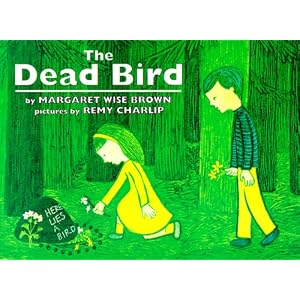
Click on the photo above to access a list of children's books about death from NAEYC.
I try to make a point of being seen. Sometimes, when I'm out, I'll buy a juice even though I'm not thirsty. If the store is crowded I'll even go so far as dropping my change all over the floor, the nickels and dimes skidding in every direction. I'll get down on my hands and knees. It's a big effort for me to get down on my knees, even bigger effort to get up. And yet. Maybe I look like a fool...All I want is not to die on a day when I went unseen. ~ Nicole Krauss; The History of Love
A few months ago, a visiting friend asked if she could borrow a few books from me to read during her plane ride home. My new philosophy on apartment cleanliness is borrowed from the ideology of simplicity borrowed from my days of teaching at a Quaker school: stick to the basics and get rid of everything else. It's a kind of cathartic exercise for me to sell old clothes to a used clothing store down the street or pile them up into brown paper bags and dump them into the Goodwill collection dumpsters that seem to sit, lonely in the back of many neighborhood grocery stores. Although my husband might disagree, I like to think of myself as the opposite of a hoarder, with one exception - books.
The paperback books I've collected from English and Creative Writing classes over the years are one of the few things with which I can't depart. Unlike a well-worn, faded sweater or a pair of work pants too tight to button at the waist, I've spent hours curled up, reading those books, ever since I got over my initial aversion to reading when my second grade teacher took me to the fifth grade only section of the school library and allowed me to choose any book that I wanted. She tried to get me to read a book about a cat that went to outer space and another about horses, both of which I thought were silly.
"Why would a cat every go to outer space and why in the world would I want to read a book about it,'' I wondered?
While I don't re-read books very often, doing so is like visiting old friends. My favorite books sit in neat rows on our inexpensive pressed wood, dining room bookshelf that was one of my first furniture purchases when I moved to Washington, D.C. Recently read but less impressionable books messily line the high cupboards of our kitchen. I knew those 7 foot ceilings and extra kitchen cupboards would come in handy for something, certainly not extra dishes or cookware. I only pretend to cook on good days, although, I've always been a good baker of simple desserts like pies and Nestle chocolate chip cookies; the recipe on the back of the bag of chocolate chips is the best.
Every fall, when I taught preschool, I would stick whole pie pumpkins in the oven and scrape out the insides, and my classroom kids would use a potato masher to smash the pie guts into pie filling. We added spices until the fragrant smell of cinnamon and cloves filled the school air. My inner-city, D.C. kids, who didn't know if a pumpkin grew on a vine or a tree (or maybe even a bush!) at the beginning of the school year, were going to know the taste of a pumpkin pie and roasted pumpkin seeds if I could help it.
Other books lie dormant, stacked in long, flat Tupperware containers under our platform king sized bed. If I want an under-the-bed book, my husband has to lift the bed frame as I quickly scramble to pull out a dust box, a layer of dust slowly scattering all of the just vacuumed carpet.
We tried to donate a bag of used books, twice to the local public library, but both times they were closed. My husband drove around with the bag of books in the trunk for several weeks. Then, the bag was moved to the shoe closet, where it sits upon one of my favorite pairs of shoes, gold sling-backs with black and white flowers. We considered simply throwing the books into the recycling bin, but we hate to be wasteful. When I peaked in the bag, trying to decide what to do with the books, I realized that they were mostly my husband's used college textbooks. Only a few of the books used to be mine and they were all cook books from my pre-trying-to-be-vegan days. Back then, the pumpkin pie recipe called for cow's milk and chicken eggs, not rice milk and potato starch egg re-placer. Not one of those books is a used collection of short stories or a novel.
When my visiting friend asked if she could borrow a book, I pulled a number of books from the shelves, telling her how much I had enjoyed reading each one of them, as though they were the pieces of delicious pumpkin pie or crisp, sweet-sour apples baked to perfection in a crumbled graham cracker crust. She left my apartment with a heavy, book-laden suitcase. She emailed me a few days later, telling me that she became so upset halfway through the book that she couldn't put it down until she knew what happened. She almost called me just to make sure that everything turned out okay in the end.
I hate it when people say that a book is "about" such-and-such, because a good book should just tell a story about the human condition. To put it simply, the book my friend was reading, The Art of Racing in the Rain, is told from the point of view of a dog whose female owner has cancer. I don't want to spoil the ending for those who haven't read it, but my friend stayed up all night reading that book and I don't think that she thought it had a happy ending, although, maybe she did. I think it depends on whether you consider the glass half empty or half full. I has also gave my friend Joan Dideon's, The Year of Magical Thinking, which is an autobiographical book about the year following the death of the author's husband. And a book about diets for cancer prevention. In her email, she said, "I'm starting to sense a morbid theme!!! I'm going to have to read David Sedaris to lighten the mood."
Also amongst my favorites in the prized collection of my dining room bookshelves are some of my "morbid" favorites, like William Faulkner's As I Lay Dying, James Agee's A Death in the Family, and Carol Shield's Unless, written the year before her death from breast cancer in 2003. In my defense, my graduate school professors assigned all of these books to me to read during the days when I was pursuing a M.F.A. in Creative Writing, but I suppose my friend had a point that there certainly seemed to be a morbid theme to my literary tastes. Maybe my professors were teaching literature classes designed around the theme of death, but if they were, they weren't telling us. They called it Creative Writing, after all!
When I was teaching preschool, we had a family of old gerbils who died off, one-by-one, one right after another. I was told they had been around for years before I started teaching at the school. Apparently, they were all brother (or sisters) from the same original litter. I remember coming inside from the playground during a short coffee break to find our first pet gerbil dead in it's glass cage. My first instinct was to take the cage to the trashcan in the teacher's lounge, dump the remains in the black Glad bag, carry it outside to the dumpsters behind the school, and hope that the kids didn't notice that the gerbil was gone when they came inside from the playground.
I now work at an organization that accredits early education programs and one of our criteria within the curriculum standard states that children be provided the opportunity to learn about life cycles of various organisms, including butterflies and humans. Gerbils are not directly mentioned, but I was fortunate enough to work with a teacher more experienced than myself who insisted that I tell the children about our pet gerbil's death, which would give them the opportunity to learn from the experience. Of course, it helped that she also offered to dispose of the gerbil's remains.
In any case, after the first gerbil died, I brought the kids inside that day, helping them to peal off all of their woolen hats and mittens from their sweaty little heads, and then we had a gerbil funeral. The seasoned teacher brought in a nice box for "Gerby" and the kids placed little pieces of paper and craft feathers on top of the box to keep him warm. We read Margaret Wise Brown's The Dead Bird, which ends with the words "...and every day, until they forgot, they went and sang to their little dead bird, and put fresh flowers on his grave." Then, I sang the class' favorite children's song of the moment, "Twinkle, Twinkle, Little Star," as my teacher friend held the gerbil over the trashcan, which always seemed to smell of rotting lunch leftovers no matter how many times I seemed to scrub it. Don't worry, I made the kids wash their hands with soap and water afterwards and we washed until we sang the alphabet song all the way through.
Unfortunately, after my teacher friend left the school to teach elsewhere, I realized that I never asked her what she did with all of the pet classroom gerbils that died that year. Did she bury them in the garden or did she just throw them in the dumpsters in the alley behind the school? I suppose we'll never know.
The following year, we tried out a hermit crab, which would have been a great pet if it hadn't pinched a little boy on the hand and he hadn't dropped "Hermy" onto the floor. Poor Hermy died the next day from the trauma.
Then, there was a pet beta fish that I accidentally dropped in the drain of the sink while cleaning his fish bowl. My co-teacher managed to scoop him up and plop him back in his water bowl, but he died the next day from the trauma, too.
Every spring, there was a butterfly unit. Ordering butterfly larvae from a science supplier and hanging a butter fly net in the middle of the classroom, we fed the caterpillars sugar water until they grew wings. If the kids touched the sides of the net house too much, the butterflies would develop crooked wings and couldn't fly away. I guess there's a reason why my husband and I don't have any pets, but one of my students who returned to my class when his brother was enrolled would never forget those butterflies.
"Remember those bugs that used to hang from the ceiling?" he said. "Why did you put them there?" He was afraid of bugs, it turns out, and had been frightened of them the whole time, although he had never told me that when he was in my class.
One summer, while I was teaching preschool, I had to use four weeks of vacation time at the end of the fiscal year or lose all of my vacation time, as it was against school policy to roll over annual leave. I had a hard enough time leaving my class for two hours in the afternoon while I attended graduate school classes on campus; it was going to be difficult for me to leave my class for four whole weeks, although I was looked forward to the time off.
The kids used to line up at the window and wave at me. I would rush off to class, wondering if I had finished peer-editing all of my classmate's short stories that week. In those days, I taught at a school that didn't offer a consistent lunch break and I would oftentimes try to put my classroom full of twenty 2-year-old children to sleep at nap time instead of doing my graduate school homework.
When my professor asked us to report on what we had read and written that week, I would lie and say that I was in the middle of reading a book that I had already read. I knew my professor well enough to know that you should never tell him that you had been too busy that week to read or write. After one of my classmates admitted that he hadn't written or read anything because his young children had been sick with the stomach flu, my professor lectured us for an hour about how reading and writing every day of his life had turned him into the celebrated writer that he was. I remember thinking that it was easy for my professor to say that it was imperative to read and write every single day. He taught evening courses and many of us doubted that he ever read our stories, which afforded him the luxury of having the full day to read and write at his leisure. I didn't know him personally, but he probably wasn't the parent who stayed up with his kids as they puked their guts out, either. Of course, I didn't say any of this aloud. I was 22 years old and hadn't written anything worthwhile. He was probably in his 60's and had published more than I can describe here.
In preparation for my vacation, I wrote a month's worth of lesson plans and labeled twenty days worth of file folders. Inside, I tucked in each day's picture book, the songs to be sung, and a pile of arts and crafts supplies for the group activity. I left detailed instructions for my assistant teachers, even though they were capable of running the classroom perfectly well without me, including little notes on everything from food allergies to challenging behaviors to each child's personality.
The funny thing is that when I returned from my month long vacation (which was spent, not traveling, but taking a graduate school summer course), the twenty 2-year-old children that had greeted me with hugs every morning and held onto my legs every time I left the classroom only a month before no longer remembered me. When I entered the classroom that first day, they stared at me, wide-eyed like they didn't know my name. I recall one particular little boy with blond hair and blue eyes who didn't say very much but would take me by the hand and pull me along, pointing at whatever it was that he wanted. I could tell that he had no idea who I was, but I still remember clearly how I woke him up from nap one day. Rushing through diaper changes, as he stood in front of me with his diaper off, I asked him if he would like to try to sit on the toilet (he was in the middle of toilet learning). He looked at me with a glazed, sleepy look on his face and urinated, right on my foot. i quickly placed him on the toilet and said something like, "Look at you! You're peeing in the potty!" I had to borrow a co-worker's pants, which were several sizes too big, while I washed my jeans in the school's washer and dryer, usually reserved for washing cot sheets and blankets after nap time.
When I went to my graduate school class that night, I explained to my classmates how a little boy had accidentally peed on my boot and a little bit on my jeans during work that day.
They looked at me, wide-eyed, like I was the silly cat in outer space from the book my second grade teacher had encouraged me to read. That afternoon in class, we sat in a circle while everyone talked about the books they were reading and all of the things they had written that week. They didn't have to drop their change on the floor, nickles and dimes flying in every direction, and make a scene while picking up their coins. They read their perfectly written stories aloud to each other in modulated tones. There was a girl who had once been an actress who could make any story read aloud sound fine. They argued about character development, plot, whether or not a story could be built on narration alone or whether it needed action, as John Gardner had so eloquently explained in the Art of Fiction, which we had all been required to read during our first Creative Writing class.
In case you don't know, the right answer is that fiction, like life, needs action in order to stand up straight when closely scrutinized. I'm not talking about the kind of action that you think of when you think of action movies. In fact, it's generally a bad idea to even mention any kind of weapon in a work of fiction, unless someone is going to pull the trigger at the end of the story. I'm talking about the kind of action that keeps that pace moving along, the kind of thing that makes a story worth reading and a life worth living, or maybe it's the other way around?
While I still may not have written anything worthwhile, I have certainly read my share of books and I could tell you stories all day about my teaching days, even if the kids I taught only remember the scary 'bugs' I used to hang from the ceiling.


No comments:
Post a Comment