Thursday, October 28, 2010

We are Stage IV and We Live Among You


As I read the following inscription engraved on a wall overlooking a fountain in Arlington National Cemetary last weekend, I didn't think of war, but what else?  Breast cancer.


In our sleep, pain that cannot forget falls drop by drop upon the heart and in our despair against our will comes wisdom through the awful grace of God.


Comparing breast cancer to war is a trite metaphor, but I suppose there are some similarities.  Many talk about "fighting" cancer.  Many call themselves "survivors."  The National Cancer Institutes's web site defines "survivor" as:
One who remains alive and continues to function during and after overcoming a serious hardship or life-threatening disease. In cancer, a person is considered to be a survivor from the time of diagnosis until the end of life.


This definition is an improvement to the original definition, which only applied to people who were cancer-free for at least 5 years.  For many of us with metastatic breast cancer, we will never be "survivors" according to this definition.


About a year ago, I picked up a breast cancer survivor button from a resource table at a conference that said something like, "I'm a survivor."  Most certainly, it was covered in pink ribbons and glitter.  It may have also have been covered in pink feathers. 


I dropped the pink survivor button as soon as I saw a woman wearing an "I hate cancer!" button.  Oh!  I like that button better! I said.


A third woman next to me gave me a quizzical look.  She said she was proud to be a "survivor."  Apparently, I had offended her.


Later during the conference, I listened as a woman described how Europeans refer to people with cancer as patients - they refuse to use the word survivor, as the later is used to refer to Holocause survivorts only.


Patients.  That term doesn't seem adequate.  People who have cancer are more than their medical experiences, though there are many days when I feel little more than a body on auto pilot who gets poked and prodded by medical professionals.  I'm not just a breast cancer patient; I am someone living with cancer. However, the static that is cancer is always buzzing around in the back of my mind like a radio's white noise. 


Some days the static is louder than others.


Ever since my original diagnosis, I've belonged to some kind of breast cancer support group.  Originally, I just wanted someone to answer my never-ending questions as I tried to understand the disease and my treatment options.  First, I tried a general online breast cancer support group.  After a woman told me that "8 out of 10 breast lumps are not cancerous" and that I was likely "too young" for breast cancer, I decided that the group was not for me. 


I don't need a 60 year old woman to tell me that I don't have cancer when I do.  No, thank you.


There are clinical trials with results that demonstrate that women who participate in support groups have better survival statistics.  My theory is that it has less to do with the psychological impact and more to do with be informed about treatment options.  I thought belonging to a support group would help me to live longer and it make me a better patient. 


Essentially, I wanted to sit in a room full of women I didn't know and talk about very personal things like having one's breast surgically removed and all of your long hair fall out in clumps, sticking between your fingers every time you run your hand through your hair.  I followed a woman wearing a wig down a hallway of a hospital, figuring that doing so would lead me to the right room.  It did and I had no problem joining right in on the conversation and talking about my personal experiences.  Most of the women were extremely kind and welcoming, but as I dragged myself to "group" once a month and talked to women online about their early stage experiences, I think I knew that it wasn't working for me.  I considered group to be just as vital to my treatment as surgery and chemotherapy.

During my first appointment with my cancer psychiatrist, I walked into the room, impatiently waited as my psychiatrist gave me a quick definition of therapy, and then began to talk about everything that had happened to me during the past year.  It was like all those thoughts I had been holding in during the past year just came spilling out.

The 'golden rule' of support groups is to maintain confidentiality - you don't repeat things said inside group to the outside world.  Honoring that rule, it's sufficient to say that after my metastatic diagnosis, I couldn't relate to women's concerns about how they would no longer be able to breastfeed, drink alcohol, or have clear skin.  Although these are all certainly valid concerns (all of which I have experienced in some way or another), not being able to drink at happy hour is the least of my worries. 


As my hair grew back and I started to look like a normal person again, post-chemotherapy, the girls from my early stage support group didn't understand why I wasn't treating my cancer more "aggressively."  They wondered why my doctor's didn't just give me more chemo.  Surely, that would knock the cancer right out of my, right?  I found myself downplaying my experiences so as not to freak them out, as I knew that I was living proof that their worst fears could come true - their cancer could come back in one or both of their breasts or, even worse, it could spread to other parts of their bodies, like their bones, lungs, brain or liver.  And yet, I looked normal and healthy; I looked just like them. 

When I asked the social worker who runs the support group if there was a group for young women with metastatic cancer, she said that there was one for metastatic cancers, but the group met on Wednesday mornings when I have to work and was attended by mostly elderly women. 


I wanted to find a support group in which I could talk about how none of the breast cancer clinical trial results seemed to address the treatment decisions I was trying to make.  All of the studies were either focused on post-menopausal women or those with early stage disease, neither of which applied to me.


I wanted to talk to someone else who had my same chances at long-term survival (something like 1%) and ask them how they got out of bed every day (I've never been a morning person and having cancer hasn't helped me in that department.)  Then, I wanted someone to tell me what I could do to live as long as possible and to maintain the best quality of life.  My personal philosphy has always been that I'd rather live well than live miserably for a long time.

Despite the hundreds of thousands of dollars breast cancer organizations raise for research, there still isn't any definitive literature on the kinds of treatment decisions that I've had to make.  During breast cancer awareness month, you can find a pink ribbon slapped on everything from water bottles to yogurt lids to yoga mats.  Unfortunately, many companies make a profit from these products and don't donate the proceeds to charities or, if they do, they only donate a small fraction of the proceeds.  The money that does get donated oftentimes goes to large drug companies that conduct research on drugs that can be marketed only to the largest demographic of women with breast cancer - women over age 40 and those with earlier stage disease, neither of which apply to me or any of the women in my current online support group.


Consider the facebook photo album, Gone too soon, which includes photographs of some of the many women who have died from breast cancer during the past few years.  This album shows a side of breast cancer that is rarely, if ever, publicized at breast cancer walks or fundraisers.  Metastatic breast cancer is the elephant in the room; it is the reality that no one wants to talk about.


As I write, read, and rewrite this blog entry, I realize that I will never have the words to capture what I want to say about the women who have lost their lives to this disease.  I remember their photographs well; I remember their stories even better - words of encouragement they sent to me about my own diagnosis and treatment, words they used to try to explain what cancer is to their young children, and words from several husbands who wrote their wives' blog entries after they were unable to write for themselves.  None of these words, however, fully convey the breadth and depth of lives these women lived.  We oftentimes say that we are speechless when someone dies.  There is plenty of truth to this statement.


One of my favorite poets, Robert Hass, states it well in Meditation at Lagunitas:
"All the new thinking is about loss...
Or the other notion that,
because there is in this world no one thing
to which the bramble of blackberry corresponds,
a word is elegy to what it signifies...
After a while I understood that,
talking this way, everything dissolves:  justice,
pine, hair, woman, you and I...
But I remember so much, the way her hands dismantled bread,
the thing her father said that hurt her, what
she dreamed. There are moments when the body is as numinous
as words, days that are the good flesh continuing.
Such tenderness, those afternoons and evenings,
saying blackberry, blackberry, blackberry."


I heard Robert Hass read this poem nearly 10 years ago at the University of Michigan.  He looked straight at a woman in the audience the entire time he spoke.  She was his wife, the poet and antiwar activist, Brenda Hillman.  In that room, you could sense what he felt towards her, but you could also hear it in his poetry.


In response to one woman's early stage breast cancer story being publicized in the media, one women wrote:
Part of me wants to live in obscurity. The other part wants to shout from the rooftops that WE ARE STAGE IV AND WE LIVE AMONG YOU!


She's a pretty smart woman.  I've frequently wanted to wear a button that says, "This is what breast cancer looks like," (like the t-shirts that say, "This is what a feminist looks like.") 


Last weekend, I visited the Arlington National Cemetery for the first time.  It was a beautiful fall Saturday, and as I wandered around the monuments, watching as tourists snapped photographs of Jacqueline Onassis Kennedy's grave, I realized that I was looking at more than a national monument and tourist attraction.  I was looking at a once living, breathing woman's grave. 
During a vacation to St. Tropes over a year ago, I took a photograph of a cemetery on a plateau near the water that seemed to sparkle in the sunlight as our tour boat passed it by.  Later, while looking through vacation photos from France, my husband asked me why I took a photo of a cemetery.  I remember thinking at the time how nice it would be to be buried there, so close to the water.  But, it was a Catholic cemetery and it was in France, so I think that it's a pretty unlikely spot for me.  It's probably not very common for a twenty-nine year old woman on a vacation with her husband, celebrating her wedding anniversary, to consider things like this, but the static is always, constantly playing in the background.  It's my lovely white noise.


October 13 is National Metastatic Breast Cancer Awareness Day; October is Breast Cancer Awareness Month.  There are endless marketing slogans related to breast cancer that do not address the potential deadliness of this disease and its prevalence among young women, but some are pretty close.


Young women can and do get breast cancer.


Breast cancer is more than a pink ribbon.


And, despite what one large, national breast cancer organization in particular would lead you to believe, there is no cure for metastatic breast cancer.


The Young Survival Coalition publishes the following statistics:
There are more than 250,000 women living in the U.S. who were diagnosed with breast cancer at the age of 40 or under, and approximately 10,000 young women will be diagnosed in the next year. But, despite the fact that breast cancer is the leading cause of cancer death in women ages 15 to 54:
  • Many young women and their doctors are unaware that they are at risk for breast cancer.
  • There is no effective breast cancer screening tool for women 40 and under.
  • Young women are often diagnosed at a later stage than their older counterparts.
  • There is very little research focused on issues unique to this younger population, such as fertility, pregnancy, genetic predisposition, the impact of hormonal status on the effectiveness of treatment, psycho-social and long-term survivorship issues and higher mortality rates for young women, particularly for African-Americans and Latinas.
  • Young women diagnosed with breast cancer often feel isolated and have little contact with peers who can relate to what they are experiencing.
  • As the incidence of young women with breast cancer is much lower than in older women, young women are underrepresented in many research studies.
The SEER (Surveillance Epidemiology and End Results) breast cancer fact sheet states:
It is estimated that 207,090 women will be diagnosed with and 39,840 women will die of cancer of the breast in 2010.


There is not a day, an hour, or a minute when I forget that I have breast cancer and I refuse to forget the woman who have died because of it.


Is breast cancer a pink ribbon?
No.


Do I think that we need more than one day or one month per year to convey the true message about breast cancer?
Absolutely.


Does everyone around me wish that I would just shut up about breast cancer and move on with my life? 
Probably.  Yes.  All the time.


Do I consider myself to be a survivor?
Nope.  I'm a person and I have cancer.  Today, I'm alive and for that, I am grateful.


Will there ever be a cure? 
I certainly hope so. 


I recently read a magazine article written by a mother of a young woman with cancer.  The mother described how their morning routine involved driving to the cancer clinic where they would wait in the parking lot for the doors to open so that her daughter could get a morphine injection to relieve her cancer pain.  Later, as the daughter continued to experience more and more pain, the hospice facility where she was being treated began completing paperwork so that she could be put into a drug-induced coma.  The infusion nurse drove to hospice in the middle of the day to visit her patient and in an effort to comfort her, she wrapped her arms around her, but she was beyond comfort.  She died only a few hours later.  I can only think of one word to describe that story and it is:  brutal.  


After I finished reading the article, I wondered why a magazine targeted towards woman's health would include this story.  I didn't want to think about anyone in that much pain, but the story was raw.  It was real.  And it had nothing to do with pink ribbons.

In memory to all my friends who have lost their lives to breast cancer in the past two years, we love you and you are missed.

Wednesday, October 20, 2010

Books: The History of Love and The Dead Bird

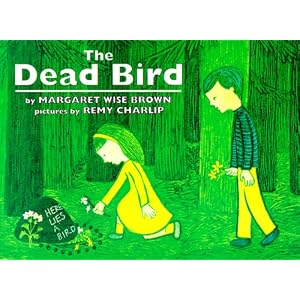
The Dead Bird
Click on the photo above to access a list of children's books about death from NAEYC.

I try to make a point of being seen.  Sometimes, when I'm out, I'll buy a juice even though I'm not thirsty.  If the store is crowded I'll even go so far as dropping my change all over the floor, the nickels and dimes skidding in every direction.  I'll get down on my hands and knees.  It's a big effort for me to get down on my knees, even bigger effort to get up.  And yet.  Maybe I look like a fool...All I want is not to die on a day when I went unseen.  ~ Nicole Krauss; The History of Love

A few months ago, a visiting friend asked if she could borrow a few books from me to read during her plane ride home.  My new philosophy on apartment cleanliness is borrowed from the ideology of simplicity borrowed from my days of teaching at a Quaker school: stick to the basics and get rid of everything else.  It's a kind of cathartic exercise for me to sell old clothes to a used clothing store down the street or pile them up into brown paper bags and dump them into the Goodwill collection dumpsters that seem to sit, lonely in the back of many neighborhood grocery stores.  Although my husband might disagree, I like to think of myself as the opposite of a hoarder, with one exception - books.

The paperback books I've collected from English and Creative Writing classes over the years are one of the few things with which I can't depart.  Unlike a well-worn, faded sweater or a pair of work pants too tight to button at the waist, I've spent hours curled up, reading those books, ever since I got over my initial aversion to reading when my second grade teacher took me to the fifth grade only section of the school library and allowed me to choose any book that I wanted.  She tried to get me to read a book about a cat that went to outer space and another about horses, both of which I thought were silly. 

"Why would a cat every go to outer space and why in the world would I want to read a book about it,'' I wondered? 

While I don't re-read books very often, doing so is like visiting old friends.  My favorite books sit in neat rows on our inexpensive pressed wood, dining room bookshelf that was one of my first furniture purchases when I moved to Washington, D.C.  Recently read but less impressionable books messily line the high cupboards of our kitchen.  I knew those 7 foot ceilings and extra kitchen cupboards would come in handy for something, certainly not extra dishes or cookware.  I only pretend to cook on good days, although, I've always been a good baker of simple desserts like pies and Nestle chocolate chip cookies; the recipe on the back of the bag of chocolate chips is the best. 

Every fall, when I taught preschool, I would stick whole pie pumpkins in the oven and scrape out the insides, and my classroom kids would use a potato masher to smash the pie guts into pie filling.  We added spices until the fragrant smell of cinnamon and cloves filled the school air.  My inner-city, D.C. kids, who didn't know if a pumpkin grew on a vine or a tree (or maybe even a bush!) at the beginning of the school year, were going to know the taste of a pumpkin pie and roasted pumpkin seeds if I could help it.

Other books lie dormant, stacked in long, flat Tupperware containers under our platform king sized bed.  If I want an under-the-bed book, my husband has to lift the bed frame as I quickly scramble to pull out a dust box, a layer of dust slowly scattering all of the just vacuumed carpet.

We tried to donate a bag of used books, twice to the local public library, but both times they were closed.  My husband drove around with the bag of books in the trunk for several weeks.  Then, the bag was moved to the shoe closet, where it sits upon one of my favorite pairs of shoes, gold sling-backs with black and white flowers.  We considered simply throwing the books into the recycling bin, but we hate to be wasteful.  When I peaked in the bag, trying to decide what to do with the books, I realized that they were mostly my husband's used college textbooks.  Only a few of the books used to be mine and they were all cook books from my pre-trying-to-be-vegan days.  Back then, the pumpkin pie recipe called for cow's milk and chicken eggs, not rice milk and potato starch egg re-placer.  Not one of those books is a used collection of short stories or a novel.

When my visiting friend asked if she could borrow a book, I pulled a number of books from the shelves, telling her how much I had enjoyed reading each one of them, as though they were the pieces of delicious pumpkin pie or crisp, sweet-sour apples baked to perfection in a crumbled graham cracker crust.  She left my apartment with a heavy, book-laden suitcase.  She emailed me a few days later, telling me that she became so upset halfway through the book that she couldn't put it down until she knew what happened.  She almost called me just to make sure that everything turned out okay in the end. 

I hate it when people say that a book is "about" such-and-such, because a good book should just tell a story about the human condition.  To put it simply, the book my friend was reading, The Art of Racing in the Rain, is told from the point of view of a dog whose female owner has cancer.  I don't want to spoil the ending for those who haven't read it, but my friend stayed up all night reading that book and I don't think that she thought it had a happy ending, although, maybe she did.  I think it depends on whether you consider the glass half empty or half full.  I has also gave my friend Joan Dideon's, The Year of Magical Thinking, which is an autobiographical book about the year following the death of the author's husband.  And a book about diets for cancer prevention.  In her email, she said, "I'm starting to sense a morbid theme!!!  I'm going to have to read David Sedaris to lighten the mood."

Also amongst my favorites in the prized collection of my dining room bookshelves are some of my "morbid" favorites, like William Faulkner's As I Lay Dying, James Agee's A Death in the Family, and Carol Shield's Unless, written the year before her death from breast cancer in 2003.  In my defense, my graduate school professors assigned all of these books to me to read during the days when I was pursuing a M.F.A. in Creative Writing, but I suppose my friend had a point that there certainly seemed to be a morbid theme to my literary tastes.  Maybe my professors were teaching literature classes designed around the theme of death, but if they were, they weren't telling us.  They called it Creative Writing, after all!

When I was teaching preschool, we had a family of old gerbils who died off, one-by-one, one right after another.  I was told they had been around for years before I started teaching at the school.  Apparently, they were all brother (or sisters) from the same original litter.  I remember coming inside from the playground during a short coffee break to find our first pet gerbil dead in it's glass cage.  My first instinct was to take the cage to the trashcan in the teacher's lounge, dump the remains in the black Glad bag, carry it outside to the dumpsters behind the school, and hope that the kids didn't notice that the gerbil was gone when they came inside from the playground.

I now work at an organization that accredits early education programs and one of our criteria within the curriculum standard states that children be provided the opportunity to learn about life cycles of various organisms, including butterflies and humans.  Gerbils are not directly mentioned, but I was fortunate enough to work with a teacher more experienced than myself who insisted that I tell the children about our pet gerbil's death, which would give them the opportunity to learn from the experience.  Of course, it helped that she also offered to dispose of the gerbil's remains. 

In any case, after the first gerbil died, I brought the kids inside that day, helping them to peal off all of their woolen hats and mittens from their sweaty little heads, and then we had a gerbil funeral.  The seasoned teacher brought in a nice box for "Gerby" and the kids placed little pieces of paper and craft feathers on top of the box to keep him warm.  We read Margaret Wise Brown's The Dead Bird, which ends with the words "...and every day, until they forgot, they went and sang to their little dead bird, and put fresh flowers on his grave."  Then, I sang the class' favorite children's song of the moment, "Twinkle, Twinkle, Little Star," as my teacher friend held the gerbil over the trashcan, which always seemed to smell of rotting lunch leftovers no matter how many times I seemed to scrub it.  Don't worry, I made the kids wash their hands with soap and water afterwards and we washed until we sang the alphabet song all the way through.

Unfortunately, after my teacher friend left the school to teach elsewhere, I realized that I never asked her what she did with all of the pet classroom gerbils that died that year.  Did she bury them in the garden or did she just throw them in the dumpsters in the alley behind the school?  I suppose we'll never know. 

The following year, we tried out a hermit crab, which would have been a great pet if it hadn't pinched a little boy on the hand and he hadn't dropped "Hermy" onto the floor.  Poor Hermy died the next day from the trauma.

Then, there was a pet beta fish that I accidentally dropped in the drain of the sink while cleaning his fish bowl.  My co-teacher managed to scoop him up and plop him back in his water bowl, but he died the next day from the trauma, too. 

Every spring, there was a butterfly unit.  Ordering butterfly larvae from a science supplier and hanging a butter fly net in the middle of the classroom, we fed the caterpillars sugar water until they grew wings. If the kids touched the sides of the net house too much, the butterflies would develop crooked wings and couldn't fly away.  I guess there's a reason why my husband and I don't have any pets, but one of my students who returned to my class when his brother was enrolled would never forget those butterflies.

"Remember those bugs that used to hang from the ceiling?" he said.  "Why did you put them there?"  He was afraid of bugs, it turns out, and had been frightened of them the whole time, although he had never told me that when he was in my class.

One summer, while I was teaching preschool, I had to use four weeks of vacation time at the end of the fiscal year or lose all of my vacation time, as it was against school policy to roll over annual leave.  I had a hard enough time leaving my class for two hours in the afternoon while I attended graduate school classes on campus; it was going to be difficult for me to leave my class for four whole weeks, although I was looked forward to the time off. 

The kids used to line up at the window and wave at me.  I would rush off to class, wondering if I had finished peer-editing all of my classmate's short stories that week.  In those days, I taught at a school that didn't offer a consistent lunch break and I would oftentimes try to put my classroom full of twenty 2-year-old children to sleep at nap time instead of doing my graduate school homework. 

When my professor asked us to report on what we had read and written that week, I would lie and say that I was in the middle of reading a book that I had already read.  I knew my professor well enough to know that you should never tell him that you had been too busy that week to read or write.  After one of my classmates admitted that he hadn't written or read anything because his young children had been sick with the stomach flu, my professor lectured us for an hour about how reading and writing every day of his life had turned him into the celebrated writer that he was.  I remember thinking that it was easy for my professor to say that it was imperative to read and write every single day.  He taught evening courses and many of us doubted that he ever read our stories, which afforded him the luxury of having the full day to read and write at his leisure.  I didn't know him personally, but he probably wasn't the parent who stayed up with his kids as they puked their guts out, either.  Of course, I didn't say any of this aloud.  I was 22 years old and hadn't written anything worthwhile.  He was probably in his 60's and had published more than I can describe here.

In preparation for my vacation, I wrote a month's worth of lesson plans and labeled twenty days worth of file folders.  Inside, I tucked in each day's picture book, the songs to be sung, and a pile of arts and crafts supplies for the group activity.  I left detailed instructions for my assistant teachers, even though they were capable of running the classroom perfectly well without me, including little notes on everything from food allergies to challenging behaviors to each child's personality. 

The funny thing is that when I returned from my month long vacation (which was spent, not traveling, but taking a graduate school summer course), the twenty 2-year-old children that had greeted me with hugs every morning and held onto my legs every time I left the classroom only a month before no longer remembered me.  When I entered the classroom that first day, they stared at me, wide-eyed like they didn't know my name.  I recall one particular little boy with blond hair and blue eyes who didn't say very much but would take me by the hand and pull me along, pointing at whatever it was that he wanted.  I could tell that he had no idea who I was, but I still remember clearly how I woke him up from nap one day.  Rushing through diaper changes, as he stood in front of me with his diaper off, I asked him if he would like to try to sit on the toilet (he was in the middle of toilet learning).  He looked at me with a glazed, sleepy look on his face and urinated, right on my foot.  i quickly placed him on the toilet and said something like, "Look at you!  You're peeing in the potty!"  I had to borrow a co-worker's pants, which were several sizes too big, while I washed my jeans in the school's washer and dryer, usually reserved for washing cot sheets and blankets after nap time. 

When I went to my graduate school class that night, I explained to my classmates how a little boy had accidentally peed on my boot and a little bit on my jeans during work that day. 

They looked at me, wide-eyed, like I was the silly cat in outer space from the book my second grade teacher had encouraged me to read.  That afternoon in class, we sat in a circle while everyone talked about the books they were reading and all of the things they had written that week.  They didn't have to drop their change on the floor, nickles and dimes flying in every direction, and make a scene while picking up their coins.  They read their perfectly written stories aloud to each other in modulated tones.  There was a girl who had once been an actress who could make any story read aloud sound fine.  They argued about character development, plot, whether or not a story could be built on narration alone or whether it needed action, as John Gardner had so eloquently explained in the Art of Fiction, which we had all been required to read during our first Creative Writing class. 

In case you don't know, the right answer is that fiction, like life, needs action in order to stand up straight when closely scrutinized.  I'm not talking about the kind of action that you think of when you think of action movies.  In fact, it's generally a bad idea to even mention any kind of weapon in a work of fiction, unless someone is going to pull the trigger at the end of the story.  I'm talking about the kind of action that keeps that pace moving along, the kind of thing that makes a story worth reading and a life worth living, or maybe it's the other way around?

While I still may not have written anything worthwhile, I have certainly read my share of books and I could tell you stories all day about my teaching days, even if the kids I taught only remember the scary 'bugs' I used to hang from the ceiling.

Tuesday, October 12, 2010

Cybernife


When I saw my radiation oncologist today and told her that my back still hurts, even after $60,000 of cyberknife treatments, she gave me a pitiful look.  It was a look that I recognized well.  I received that same look from my oncologist during an appointment with her a few days earlier when she told me that she was disappointed that cyberknife didn't seem to be resolving the bone pain in my seventh thoracic vertebrae (go, T7!) that I've had for almost a year. 

"It's only been a month, though..."  My voice trailed off.

So many medical professionals have given me 'the look:'
  • an anesthesiologist squeezing my shoulder and wheeling me back to my first lumpectomy, 
  • a lung specialist explaining that I would not be asleep during a broncoscopy (and then a nurse squeezing my hand during the procedure),
  • a lung specialist delivering the news that the spots on my lungs in the scans we were reviewing were most likely cancer.  Surprise!  Two oncologists, a breast surgeon, and a thoracic surgeon had already told me this same news. 
Not batting an eyelash, I said, "I know, but how are you going to biopsy my lung?"  I wanted to know which surgical option was the least painful. 

"How would I know?" she said.  "I've never had a lung biopsied before."

Really, I thought.  Just shocking!  You seem so empathetic and understanding about it.  I'm amazed that you don't have any first hand experience in this department.

No, the pity look is not "blue steel" but it's almost as good.  And yes, I know that I just included a bulleted list of pity looks.  I'm a nerd.

Apparently, when you have cancer, you get to receive the 'pity look' from multiple cancer specialists.  You also get to hear the same diagnosis over and over again from more than one person.  This is because there's a medical professional for, like, every part of your body, and every type of treatment prescribed.  You get the whole package - a breast surgeon to operate on the breast, a thoracic surgeon to biopsy lung tissue, a lung specialist to stick a broncoscope through up your nose and through your lungs, an oncologist to prescribe chemo and hormone therapy, an oncology nurse to pump medicine through your veins, and a radiation oncologist to zap diseased bones.  A neursurgeon to tell you, "Gee, you're awfully young to have breast cancer.  You must have a family history."  A phelbotomist in the genetic testing unit to tell you how "lucky" you are to have caught your cancer while you were still "young," unlike his ex-wife who had to have her breast "cut off" - his words, not mine.   

Yep.  You get to meet all sorts of interesting people.

About a month ago, my lovely T7 vertebrae, which looks like a hot mess of a moth eaten bone on the MRI images and feels just as lovely, was "zapped" with cyberknife radiation.  During treatment, I listened to Nora Jones, Jack Johnson, and a third CD I can't remember while I tried to hold very still on a hard, flat table as a space-age looking machine whirled above my head.  I refused to look at the machine at first.  Worried that looking at it would freak me out, I squeezed my eyes closed like a child watching but not watching a horror movie, peaking out every few minutes from scrunched up eyes. 

When my radiation oncologist's receptionist told me that I could bring a CD to listen to during treatment, I considered bringing Dane Cook's "Retaliation" or "Harmful if Swallowed," both of which include jokes funny enough to make anyone with a sense of humor accidentally wet themselves.  I used to listen to Dane Cook jokes on my ipod while riding the metro to work in an effort to contain my anger at middle-aged men in suits who ignored pregant ladies and elderly people, wobbling overhead, hoping that someone would be gracious enough to offer them a seat.  Dane Cook is so funny that when I listened to him on the metro, I laughed to myself, while the middle-aged, pregnant and elderly alike looked at me like I was a crazy lunatic.  So, I decided that Dane Cook might be the cause of my ultimate demise on the radiation table and tried to find a CD from my small collection that would be more suitable for lying still for over an hour.

Part of my decision to have cyberknife radiation in the first place was that I thought it sounded very technical and important.  The intent was to zap the pain away.  "Cyber" anything sounds kind of neat, right?  It reminds me of a fictional treatment from a show like Star Wars or Stark Trek or something with "star" in the title.  Everything I read about cybernkife said that it was very effective with minimal side effects, which sounded too good to be true.  Cyerknife is no Urban Outfitters; it's the Anthropologie of cancer treament, or, more like the Gucci or Prada.

I haven't purchased a CD since I got an ipod several years ago.  My most recent CD, Nora Jones' "Come Away with Me," was released in 2002, the year I graduated from U of M.  I walked down the isle at my wedding to that song.  It was a grassy lawn of an isle, but it was still an isle.

On Day 1 of cybernkife, as the radiation techinician asked me if I was ready to start, I began to think I'd chosen the wrong CD.

The radiation oncology department is not very feng shui.  It's located in the basement on the lower level of the hospital, without any natural sunlight.  It's pretty dreary, although it's well-stocked with plenty of wrinkled copies of frivolous women's magazines from last season.  There's nothing like reading about sweaters and boots when it's 90 degrees and sunny outside.  The actual cyberknife treatment room is located upstairs, but only scores about a point or two more on the cheerfulness scale.

To open the door guarding the entrance to the "Wound Healing and Cyberknife Department" (weird combo, I know), you have to push a button mounted on the wall.  Then, the doors slowly open in the way that a child might imagine the entrance to a spaceship opening.  Hanging on the walls are life-sized photographs of exotic creatures right out of the pages of National Geographic magazine.  The waiting room walls are lined with photos of various species of birds, from penguins to peacocks.  The radiation technician that gave me a tour on Day 1 told me that the restroom was across from "Turtle Boulevard," named after the photograph of a turtle hanging closeby.  Ha, ha.  He was a joker.  His jokes were almost as bad as mine, but probably twice as funny.

The tech asked me if I had any metal in my undergarments (Um, no?) and told me that I didn't need to change from my pencil skirt into the sweatpants they told me to bring.  He showed me the computer screens they would use to monitor my treatment.  He explained that the techs would sit in a little foyer just outside the treatment room, on the other side of a very heavy metal door meant to protect the techs.  They wouldn't want to "catch" cancer from all that radiation, after all!  They'd be able to hear and see my every move via a closed circuit television system.  The wall of computer monitoring screens reminded me of the casino monitors from Vegas movies like "Ocean's Eleven." 

If I had to use the restroom, had to itch my nose, or had to cough, I was supposed to warn the techs that I might need to move in about 5 minutes.  If I had an "emergency," I could tell them to stop the radiation immediately.  What type of emergency I might have, I wasn't sure.  The tech said that I wouldn't be able to feel the treatment, so it wasn't going to hurt.  I suppose it could have made me puke, or something, in which case, I wasn't quite sure that I would be able to muster up an explanation in time. 

Imagine me saying, "Um, stop the radiation, pretty please, so that I may throw up my lunch all over your nice, expensive machine in approximately 4.79 mintues.  Let's count down.  5, 4, 3, 2, 1!  And here's the vomitting blast off.  Thank you."

One of Dane Cook's jokes goes like this, "I don't like a girl who exagerates.  I can't listen to your stories when you exagerate because I listen; I hear you.  When I listen to your story, I listen to the exageration.  You would be very sick if you took a hundred hour nap.  Just say that you took a coma and I could follow you."
 
Ha, ha, Dane.  You're so funny!  Stop making me laugh so hard.  You're going to make me slice my spinal cord, or at the very least, wet myself, and nobody wants that, least of all the radiation tech.  He would have to clean up after me.

You know, it's harder to lie perfectly still for an hour than you might think.  That's why yogis practice savasana for years to get it right.  After the tech closed the door to the treatment room, my knees propped up on a triangular pillow and a light blanket tucket around my barefeet (I had kicked off my flip-flops), I didn't feel very successful at holding still.  My heart seemed to pound too quickly, I was panting like a thirsty dog, and felt like I was swallowing every two seconds.  Of course, I don't think the techs could see any of that from their monitors, but it felt like they could.

"Whatever you do, don't move your head!" the tech told me during my tour.  "It's connected to your spine, you know.  If your head moves, so does your spine."

Maybe he was trying to be funny, but while I lay on the table, I kept picturing myself coughing or letting my head roll slightly to one side over the course of an hour.  The radiation beam would slice through my spinal cord and cause me to become paralyzed.  Not really.  I don't think that can happen, but sometimes the mind exagerates.

As I listened to Nora Jones' song, "Come Away with Me," my heart thumping along, I worried that the song would no longer remind me of my wedding day.  Instead, I would think about how I had once been on a table, in a cold, dark room with a light installation of cherry blossoms on the ceiling, like those posters they have at the dentist's office, with a cyber-age robot arm whirring above.  Music and scents have a weird way of sticking in my memory and I didn't want Nora Jones to get stuck in the cyber world in the bowels of the hospital and not be able to leave.

When I was 8 years old, my mom took me to the mall to get my ears pierced.  I wanted to get both ears pierced at the same time because I was afraid that if they pierced one ear and it hurt, I wouldn't let them pierce the second ear.  So, two ladies working at the jewelry store agreed to pierce my ears at the same time.  First, they disinfected my ears with rubbing alcohol.  The smell made me feel like I was going to pass out and the drama started.  I guess I was kind of a weird kid to know that the scent of rubbing alchohol meant impending pain and to know myself well enough to know that I would refuse the second, gaudy gold heart earing if the first piercing was awful, but I recovered quickly, got my piercings, and afterwards, we had pizza at Pizza Hut.  Even though I left the store, giddy with my throbbing pierced ears, the smell of rubbing alcohol still makes me light headed to this day.  The taste of heparin, which my infusion nurse gives at every medi-port flush and infusion has the same affect.

The strange thing is, that a month after radiation, I can't even remember the name of the CD that I listened to on the third day of radiation treatment, when I fell into synk with the routine.  I had a new radiation tech on Day 2 who looked like President Obama and spoke in a moderated tone like him, too.  He didn't tell me any awful jokes and when the doors to the radiation room opened at the end of treatment, he apologized for allowing my CD to skip and for playing it much too loudly.  Apparently, the elderly gentleman who received radiation before me had requested that his biblical CDs be played really loudly and the tech had forgotten to turn the speaker volume down.  I gave the tech 'a look,' not of pity, but that said, "I wouldn't listed to the Bible during radiation."  He smiled and lowered the radiation table.  He said he liked my short haircut and didn't seem to care when I explained that it was my "post-chemo" hairdo.

"You have really nice highlights. I noticed them while you were getting treatment," somehow, he managed to say, without sounding creepy.  

Day 3 of cyberknife. I didn't know if the treatment would help my T7 pain or not.  The tech didn't know much about me, except what my radiation oncologist had included in the manila colored file that I had seen on the tech's desk.

I was the girl who brought in her own CDs, lied perfectly still on a radiation table for over an hour, and didn't complain even though my radiation tech blasted my CD like I was jamming.

I walked away from the cybernkife room and as I continued down the hall, passing the waiting room filled with photographs of birds, I realized that I had forgotten my CD, but I didn't turn around to get it.  The tech came running down the hallway after me.

"You forgot your CD," he said, and handed it over.

"Thanks," I said, and put it in my backpack.

That night, I walked past the taxi stand at the hospital, past the bus stop, and through Georgetown until I almost reached Key Bridge.  I stopped for frozen yogurt with berries and chocolate chips on top.  It was tart, sweet ice-cream and I ate it while I walked all the way home.